Studious Digital Education is an exciting new UK-based EdTech start-up founded in 2018. You have been appointed as a management consultant to analyse opportunities for business growth.
The leadership team has requested you produce a report that must contain the following information:
Introduction (approx. 100 words) – Provide a brief introduction to the report in terms of the context and what will be covered.
Situation Analysis (approx. 1,100 words)- in order to understand the current position of Studious and the online education sector in which it operates, conduct a SWOT analysis identifying the organisation’s strengths, weaknesses in terms of its resources and capabilities, along with the opportunities and threats present in the external environment.
To establish the current state of the industry Studious falls within, conduct an industry analysis utilising Porter’s Five Competitive Forces framework. Provide a ranking of the Five Forces within the framework and discuss the two strongest forces along with the action the organisation needs to be taking in order to ‘manage’ two of the strongest forces.
Studious’ current competitive position in the market place is ‘Focused Differentiation’ (Porter, 1980). As Studious continues to grow, apply Porter’s Generic Strategy to consider what is the best strategic option for the business in the next five years.
Marketing & Growth Opportunities (approx. 1,100 words)
The leadership team are keen to hear your thoughts on international expansion and therefore request that you identify one country (not the UK) which could be a viable growth option. To do this apply and analyse three factors from PESTEL to support your country justification.
Aside from international growth, what are other opportunities for strategic growth? Using any of the four vectors in the Ansoff Matrix evaluate and generate three additional potential growth options:
market penetration – what opportunities are there to sell more to their current customers with its existing products or services?
market development – what opportunities are there to sell its existing products or services to new customers?
product development – anticipating changes in existing customer needs, what products or services need to be developed to meet those needs?
diversification – what opportunities are there to enter into a completely new market or product area, outside of where Studious currently competes.
Finally, take the key customer segment(s) of Studious (existing or new), profile the segment(s) using two of the following factors Demographic, Geographic, Behavioural and Psychographic factors. Then explain how you will reach these targeted segment(s) with the purpose of generating the maximum customer value by applying two aspects of the Marketing Mix (4Ps).
Conclude the report (approx. 200 words) – present as a ‘Force Field Analysis’ which lists and ranks the strengths of the driving forces and the restraining forces of one of the growth opportunities discussed in the report. Accompany the Force Field analysis with a discussion summarising the outcome of the Force Field Analysis.
STUDIOUS DIGITAL EDUCATION OPPORTUNITIES FOR BUSINESS GROWTH
Any business aims at growing in size by increasing market coverage to international markets (Dangi et al., 2019, p 65). Business growth has no distinct metric of measurement and refers to expansion in one or more ways. Most businesses grow by increasing sales and strengthening market position. Other data points that show growth include revenue, company value, number of employees, and customers. This report analyses Studious Digital Education growth opportunities. It consists of the company’s situation analysis using SWOT analysis and Porter’s five forces and market and growth opportunities analysis using PESTEL, Ansoff Matrix, and customer segmentation.
Studious Digital Education is an e-learning platform that equips students, lecturers, and organisations with digital resources (Studious, 2021). It produces digital learning content and media resources for organisations and universities to purchase or licensed to use (Studious, 2021). Ryze, the company’s application, allows universities to host their content on a cutting-edge learning experience. The app offers exceptional interactivity, networking features, artificial intelligence, adaptive learning capability, analytics, and nudge technology. Studious Digital Education showed its potential during the COVID-19 pandemic, where learning institutions were closed. Some of them invested in digital learning by acquiring services of e-learning companies to mitigate the problem.
The SWOT analysis shows the company’s strengths and weaknesses regarding capabilities and resources and opportunities and threats in the external environment. Understanding Studious Digital Education’s internal strengths and opportunities are essential in determining its potential to take advantage of its opportunities and mitigate threats (Bapat and Hole, 2020, P 12706). Table 1 below shows a summary of Studious Digital Education SWOT analysis.
Table 1. SWOT
| Strengths
· Flexibility · High interactivity · Highly motivating · Accessibility · Wide learning approaches · Innovation |
Weaknesses
· Incompatibility · Limited physical interaction · Educator market issues · Inadequate I.C.T. infrastructure · Limited proctoring |
| Opportunities
· Global expansion · Diversifying to other services · Free data plans
|
Threats
· Exaggeration of positive impacts · Cheating · Costly equipment · Online insecurity · Competition
|
Studious Digital Education company is flexible since it can accommodate changes in management, location, and education systems. It can offer its services to different educational institutions irrespective of their systems (Boca, 2015, p 10). The platform is also highly interactive due to its immediate response to concerns. Users can get personalized responses from the company due to the interactivity. The platform is also easily accessible as long as one can access the internet (Studious, 2021). It can be accessed through a smartphone or computers via their website or application. It also synthesizes varying approaches to learning by creating many contents. The company is also innovative in creating its content and media since it adopts digital technologies highly competitive. Its platform provides solutions and feedback to users within the shortest time possible.
Incompatibility is a weakness for the company since its technological designs might not provide outputs that users desire. Students, for instance, have different learning methods, and the company’s platform might not be compatible with them. The platform also limits physical interaction between learners and educators, affecting performance (Studious, 2021). Besides, if e-learning is adopted, few educators will be hired, affecting the educators’ labour market structure. Furthermore, the platform cannot offer sufficient proctoring, especially during exams compared to the physical human proctor. Inadequate or poor distribution of I.C.T. infrastructure can lead to slow and uneven reception of the system.
Studious Digital Education has an opportunity of expanding to other markets outside the U.K. since it does not have to open subsidiaries in different markets. The systems the company has can be easily tailored to fit different markets. Diversification is another opportunity since the company can venture into other services such as finance and marketing in addition to education (Boca, 2015, p 11). Furthermore, the company can take advantage of some service providers’ free data services through partnerships to increase uptake of the platform.
The main threat of the platform is competition from large e-learning platforms. They include large multinational companies that are well established. Another threat is the high chance of exaggeration of positive impacts of the company’s services. It can lead to biased evaluation and inappropriate decision-making. Online insecurity is another threat since scammers can take advantage of innocent users or even assess sensitive data (Lavanya, Buvana, and Shanthi, 2017, P 551). Due to inefficient online proctoring, students cheating during exams is another threat facing the company. Finally, high-quality content and media require the latest technologies, which are expensive. For instance, 4K videos are appropriate when network coverage is 4G and above. The reduction in education cost due to digital learning is significant, but the government should assist by investing in necessary infrastructure and ensuring that necessary equipment and services are readily available.
Digital Education industry analysis can be done using Porter’s five forces. It gives how strong or weak the forces are to the company. The forces include the threat of new entrants, buyers’ bargaining power, competition, substitutes, and suppliers’ bargaining power (Bapat and Hole, 2020, P 12707). Studious Digital Education is relatively well established in the market and faces little impact from new entrants. Entry into the market requires huge investment, which discourages new entrants. The company faces moderate bargaining power since large learning institutions can affect the company’s decisions. However, individuals or small institutions have no influence. The global digital education market has few large firms that are competitive (Watermeyer et al., 2020, p 2). New technologies and innovations are making them more competitive over time. Thus, due to globalization, Studious Digital Education faces a strong competition threat.
The main substitute for e-learning is the traditional four-wall learning system which is not competitive (Watermeyer et al., 2020, p 2). Thus, the company faces no threats from substitutes. Studious Digital Education suppliers have moderate bargaining power since Studious Digital Education uses payment and software services from other companies. Overall, the company is less likely to be kicked out of the market due to few threats from Porter’s five forces. Thus, Porter’s five forces’ order in terms of threat to Studious Digital Education is competition, suppliers’ bargaining power, bargaining power of buyers, new entrants, and substitutes. The first and second strongest forces can be managed by adopting competitive technologies and diversifying suppliers, respectively.
Porter’s generic strategies include cost leadership, differentiation, cost focus, and differentiation focus. Studious Digital Education’s current strategy is “focused differentiation,” which involves offering a different product in consumers’ eyes irrespective of the price (Bapat and Hole, 2020, P 12715). Thus, a product development strategy that involves developing a new unique service is the best strategic option for the company in the next five years.
Marketing and Growth Opportunities
New Zealand, irrespective of its distance from the U.K., is an appropriate market for Studious Digital Education to enter. English is one of the country’s official languages, which is desirable for any business from the U.K. Besides, the country is under the effective leadership of Jacinda Ardern (Britannica, 2021). She is being celebrated as the best leader during a crisis (Britannica, 2021). Overall, the country has several similar characteristics as the U.K., which reduces the cost of venturing into the market and increases the business’s success.
New Zealand is a constitutional monarchy and parliamentary democracy. It is a middle power country as per the eight Asia-Power index thematic measures (Britannica, 2021). The country is small, stable, and peaceful, with a low corruption rate. However, there was a terrorist attack towards Muslims in 2019, but Ardern managed the situation and made the country more united (Ali and Adriano, 2019, p 27). The country discourages foreign political influences and is working on new laws to curb the influence.
New Zealand is wealthy and developed, with agriculture being the largest sector. Industries that drive the economy include forestry, horticulture, mining, fishing, and tourism. The country’s G.D.P. has been over $200 billion except in 2020 where it dropped to $193.545 billion due to the COVID-19 pandemic (Ali and Adriano, 2019, p 29). It exports goods worth over $35 billion to other countries, mainly Australia, Japan, U.S., and China. New Zealand advocates for free trade and has a mixed economy driven by free-market principles. It has a simple tax system where those earning over $70 thousands pay 33%, those earning between $14 and $70 thousand pay 10.5%, and a flat tax rate of 28% apply to all corporates and companies (Ali and Adriano, 2019, p 27). This taxation system is more straightforward compared to those of other developed countries.
New Zealand has no official religion, even though Christianity is the major one. The country has over 4.7 million, with life expectancy for men and women being 80 and 88, respectively (Ali and Adriano, 2019, p 27). The country has diverse cultures, which is considered a good thing in the country. It performs well in areas such as air quality, social support, life satisfaction, and employment. The country is connected with more than half of the population visiting food websites monthly, and many youngsters watch online videos (Ali and Adriano, 2019, p 27). New Zealanders are known in sports through rugby, cricket, netball, and field hockey. Some social challenges in the country low household income, affordability of houses, and long working hours.
The technology sector in New Zealand is advanced, diverse, and rapidly growing. Jobs such as software engineer, software and application programming, I.T. security, and other technical jobs are in demand. Some I.C.T. companies in the country have earned international standing (Britannica, 2021). This feature is good for Studious Digital Education for its business.
New Zealand has a unique environment consisting of glacial mountains, sandy beaches, lakes, and attractive rich marine life. The country enjoys a climate that is favourable for agriculture (Britannica, 2021). Environmental concerns in the country include air pollution from cars, soil erosion, deforestation, and habitat loss.
New Zealand welcomes foreign direct investment and is ranked number one in the World Bank’s ease of making business list of 2018 (Dangi et al., 2019, p 66). Its justice system is strong and independent. The minimum wage is 17.70 New Zealand dollars per hour, and employees must not pay below this wage (Britannica, 2021). No strict regulations for international companies since the government encourages foreign investors.
Ansoff matrix gives four strategic options with varying risks through a combination of changing what is being offered or who the product is being sold to (Loredana 2017, p 141), as shown in figure 1 below. Market penetration has less risk followed by product and market development, while diversification is the most risk. Studious Digital Education can take advantage of low market penetration risk to grow (Loredana 2017, p 146). The first growth potential under market penetration is lowering prices to lower new customers. The second growth option under product development is creating a platform that offers financial services to businesses in the U.K. The third potential strategy, which is still under product development, is partnering with other companies in the U.K. that offer new services such as marketing or finance. The suggested potential strategies do not include diversification since the dimension has many risks, and Studious Digital Education should begin by adopting less risky strategies. However, when the company grows to an international standard, it can consider diversification strategies.
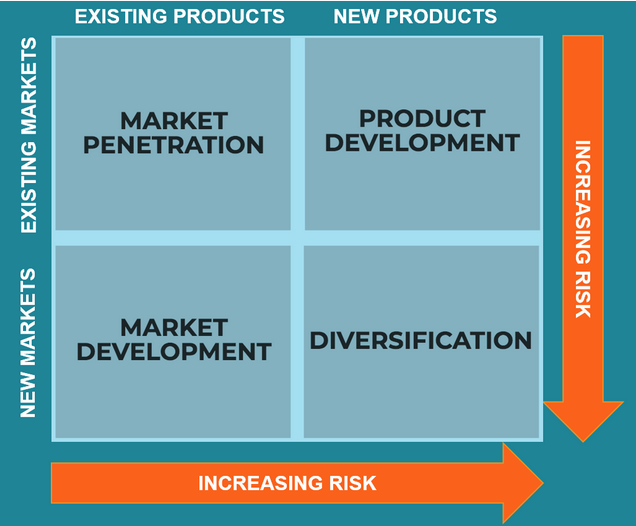
Figure 1. Ansoff Matrix
Segmenting customers is essential in developing a personalised marketing mix. Studious Digital Education new customers in New Zealand can be segmented based on psychographic, geographic, and demographic variables. New Zealand has approximately 600 islands categorized as north and south (Panuš et al., 2016, p 228). Thus, consider geographical segmentation of customers in the country based on the region they live. More than 80% of New Zealanders live in urban areas where there is easy access to internet services (Britannica, 2021). The segment of customers who live in rural areas needs more attention in generating maximum customer value. Out of the 4Ps, promotion is appropriate in marketing Studious Digital Education to this segment. Promotion, in this case, should include benefits such as free internet services, gifts, scholarships, and other charity activities (Panuš et al., 2016, p 228). Young learners are another key segment under demographics. Most young learners are cost-sensitive and consider the price of a commodity before purchasing. Thus, price is appropriate in marketing Studious Digital Education to these customers. The company should lower the price for this segment to attract them.
Studious Digital Education is a start-up but has a huge potential in growing by venturing into new products or new markets. The company’s SWOT analysis shows that it can increase its market share by utilizing its opportunities. It has several low-risk growth strategies, including cost leadership and internationalization. An industry analysis through Porter’s five forces shows that the only significant threat is competition from existing large firms. However, through differentiation and product development, Studious Digital Education can minimize the impacts of competition. The company can consider expanding to New Zealand by launching a website and an application that offer similar services as those offered in the U.K. in the country. PESTEL analysis shows that New Zealand is appropriate due to favourable conditions. However, the company should carry out customer segmentation in the new and existing markets to develop a compelling, personalized marketing mix.
Ali, E. and Adriano, R.J., 2019. Trends in FDI movement of New Zealand economy over the last two decades: an analysis. Journal of International Business, Economics, and Entrepreneurship (JIBE), 4(1), pp.27-34.
Bapat, H.B. and Hole, M.S.Y., 2020. A COMPARATIVE STUDY OF ONLINE AND OFFLINE MODE OF MANAGEMENT EDUCATION. PalArch’s Journal of Archaeology of Egypt/Egyptology, 17(7), pp.12706-12719. https://archives.palarch.nl/index.php/jae/issue/view/106
Boca, G.D., 2015. SWOT analysis and e-learning. Procedia-Social and Behavioral Sciences, 182, pp.10-14. https://scholar.google.com/citations?user=FPoBz2wAAAAJ&hl=sv
Britannica, 2021. New Zealand. Encyclopædia Britannica. Available at: https://www.britannica.com/place/New-Zealand [Accessed February 22, 2021].
Dangi, M.R.M., Ismail, A.H., Johari, R.J. and Noor, R.M., 2018. S.M.E.’s Internationalization Initiatives: Business & Growth Strategy I.C.T. and Technology. Int. J. Accounting, Finance. Bus, 3(12), pp.63-75.
Lavanya, N.A., Buvana, M. and Shanthi, D., 2017. Detection of security threats and vulnerabilities of e-learning systems in cloud computing. Advances in Natural and Applied Sciences, 11(7), pp.550-560.
Loredana, E.M., 2017. The use of Ansoff matrix in the field of business. Annals-Economy Series, 2, pp.141-149.
Panuš, J., Jonášová, H., Kantorová, K., Doležalová, M. and Horáčková, K., 2016, July. Customer segmentation utilization for differentiated approach. In 2016 International Conference on Information and Digital Technologies (IDT) (pp. 227-233). IEEE.
Studious, 2021. Who We are. Studious Digital Education. Available at: https://studious.org.uk/who-we-are/ [Accessed February 22, 2021].
Watermeyer, R., Crick, T., Knight, C., and Goodall, J., 2020. COVID-19 and digital disruption in U.K. universities: Afflictions and affordances of emergency online migration. Higher Education, pp.1-19.
As a renowned provider of the best writing services, we have selected unique features which we offer to our customers as their guarantees that will make your user experience stress-free.
Unlike other companies, our money-back guarantee ensures the safety of our customers' money. For whatever reason, the customer may request a refund; our support team assesses the ground on which the refund is requested and processes it instantly. However, our customers are lucky as they have the least chances to experience this as we are always prepared to serve you with the best.
Plagiarism is the worst academic offense that is highly punishable by all educational institutions. It's for this reason that Peachy Tutors does not condone any plagiarism. We use advanced plagiarism detection software that ensures there are no chances of similarity on your papers.
Sometimes your professor may be a little bit stubborn and needs some changes made on your paper, or you might need some customization done. All at your service, we will work on your revision till you are satisfied with the quality of work. All for Free!
We take our client's confidentiality as our highest priority; thus, we never share our client's information with third parties. Our company uses the standard encryption technology to store data and only uses trusted payment gateways.
Anytime you order your paper with us, be assured of the paper quality. Our tutors are highly skilled in researching and writing quality content that is relevant to the paper instructions and presented professionally. This makes us the best in the industry as our tutors can handle any type of paper despite its complexity.

Recent Comments