Your submitted document should include the following items. Points will be deducted if the following are not included.
Elements of good technical writing:
Use complete and coherent sentences to answer the questions.
Graphs must be appropriately titled and should refer to the context of the question.
Graphical displays must include labels with units if appropriate for each axis.
Units should always be included when referring to numerical values.
When making a comparison you must use comparative language, such as “greater than”, “less than”, or “about the same as.”
Ensure that all graphs and tables appear on one page and are not split across two pages.
Type all mathematical calculations when directed to compute an answer ‘by-hand.’
Pictures of actual handwritten work are not accepted on this assignment.
When writing mathematical expressions into your document you may use either an equation editor or common shortcuts such as: can be written as sqrt(x), can be written as p-hat, can be written as x-bar.
Problem 1: Simulating Rolling Two Four-Sided Dice (no data set)
We will be comparing empirical (relative frequencies based on an observation of a real-life process) to theoretical (long-run relative frequency) probabilities. We will use StatCrunch to simulate rolling two four-sided dice. Conduct the following simulation by using the steps below:
Step 2: In window, enter 4 for the number of sides and 2 for the number of dice. (edit)
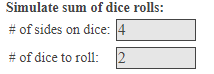
Step 3: Select Compute!
Step 4: Select 1000 runs to simulate rolling the two dice 1000 times as shown below. The result of this simulation will appear as a bar graph.
Step 5: Clear the box to the right of “Sum of 2 rolls” for part (a) (none of the bars in the chart will now be highlighted).
Step 6: Copy your chart into your document for your answer to part (a).
NOTE: You will use this result to answer parts (c) – (h).
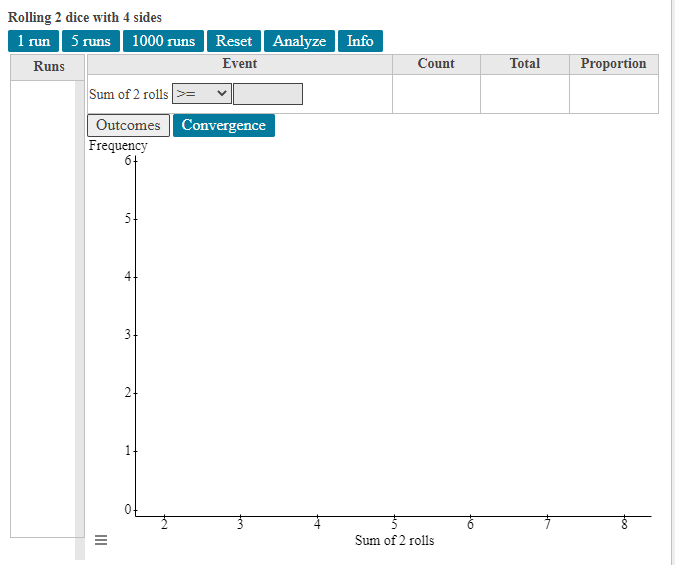
Using your result from the 1000-run simulation found in part (a), find the following three proportions for parts (c) – (h) and then compare these empirical probabilities with their theoretical probabilities. DO NOT GENERATE ANOTHER RESULT. You only need to adjust the information in boxes 1 and 2 above to answer parts (c) – (h). Please complete parts (c) – (h) in one sitting so you use the same simulation results.
Problem 2: VW Bus Auction Sales
The Volkswagen Type 2, informally known as the VW Bus, was first introduced in 1950. The first generation of the Type 2, which was produced until 1967, has an active aftermarket with vehicles frequently sold for high prices at auction. The dataset (called “VW Bus Auction Sales”) for the winning bid of 126 unrestored VW Type 2’s sold at auction are given on StatCrunch.
This can be done by going to Options à Edit in the top left corner of your graph. Inside the histogram graph box, look for Display Options. Next to “Overlay distrib.:” click the arrow next to the word –optional– and select Normal. Then, check the box next to mean under the word “Markers.” Copy and paste this histogram into your document.
For parts (g) – (l), assume that the distribution of winning bid prices in the population is normal with the mean and standard deviation found in part 2(f) (again use the rounded mean and standard deviation values). Note: you are using the normal distribution for the next three calculations.
Problem 3: GMU Student Voting Percentage (no data set)
A Mason Votes article published on November 14th, 2019 shares a table for the George Mason registration and voting rates from the 2012 to 2018 Presidential and Midterm Elections from data submitted and collected by National Student Clearinghouse and Catalist. The voting rate for all students, registered and non-registered, in the 2016 Presidential Election was 64.9%. A random sample of 15 students from GMU in Fall 2016 were selected and asked the question, “Did you vote in the 2016 Presidential Election?”
Mason Votes is a fantastic resource that provides information and guides individuals regarding registration, upcoming events, and other election news specific to George Mason University. Find more info at: http://masonvotes.gmu.edu/.
Problem 4 on the next page.
Problem 4: Building a Sampling Distribution (no data set)
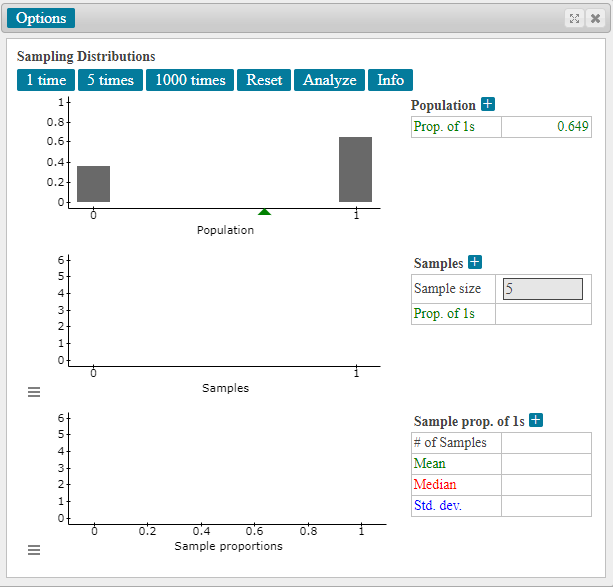
We will use the Sampling Distribution applet in StatCrunch to investigate properties of the sampling distribution of the proportion of students at GMU who voted in the 2016 Presidential Election from the previous problem. Remember, the given probability of students at Mason who voted in the 2016 Presidential Election is 0.649. We will begin by taking a sample of 5.
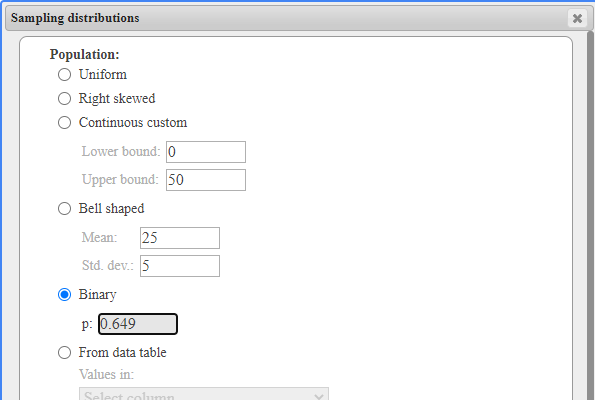
Under Applets, open the Sampling distribution applet (box shown below). First, select Binary for the population. Next, to the right of “p:”, enter 0.649 which is the probability of a student at GMU who voted in the 2016 Presidential Election. Then click on Compute! See image below.
First, draw a picture with the mean labeled and shade the area representing the desired probability. Next, standardize using the proper calculations and use the Standard Normal Table (Table 2 in your text and formula sheet) to obtain this probability. Then, take a picture of your hand drawn sketch and upload it to your document (if you do not have this technology, you may use any other method (i.e. Microsoft paint) to sketch the image). You must type the rest of your “by hand” work (e.g. the formula and calculations used to find the z-value) to earn full credit.
Provide a StatCrunch Normal graph to verify the work in part 4(l) and write one complete sentence to interpret the resulting probability in context of the question.
HINT: Remember to use the values you used in 4(l).
Problem 1: Simulating Rolling Two Four-Sided Dice (no data set)
Chart
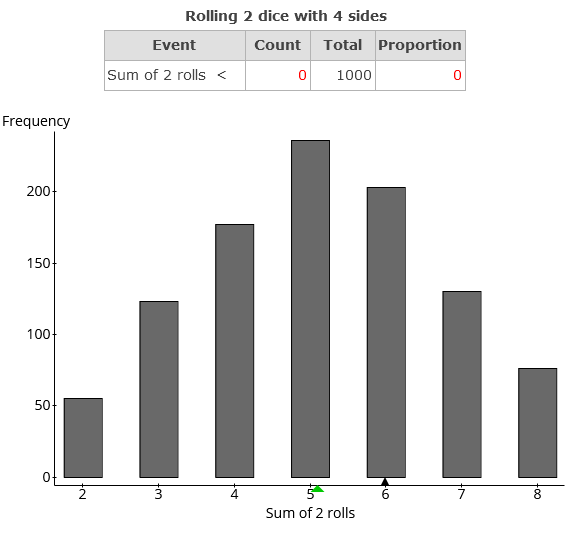
Table and Graph
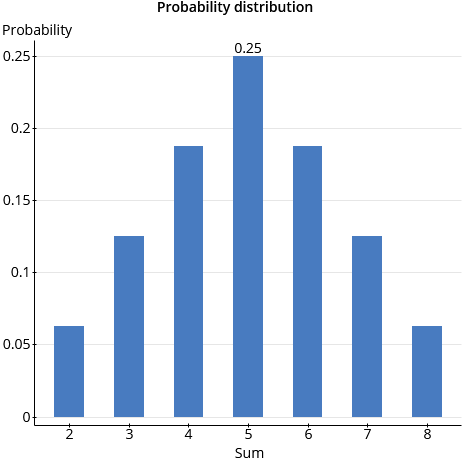
| Sum of rolls | Probability |
| 2 | 0.0625 |
| 3 | 0.125 |
| 4 | 0.1875 |
| 5 | 0.25 |
| 6 | 0.1875 |
| 7 | 0.125 |
| 8 | 0.0625 |
| 1 |
Graph, sum of 2 rolls is 7
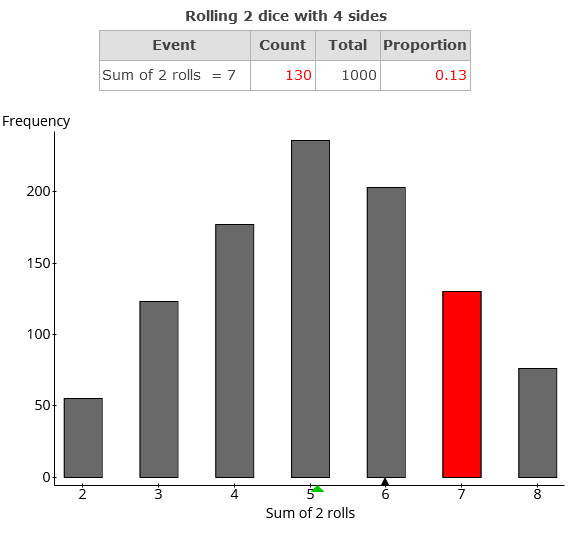
Theoretic vs empirical probability
The theoretic probability of the Sum of two rolls equals to 7 is 0.125
The empirical probability of the Sum of two rolls equals to 7 is 0.130. This difference is because the first is a hypothetical result while the second is an actual experimental result
Graph – Sum of two rolls is equal to or greater than 7
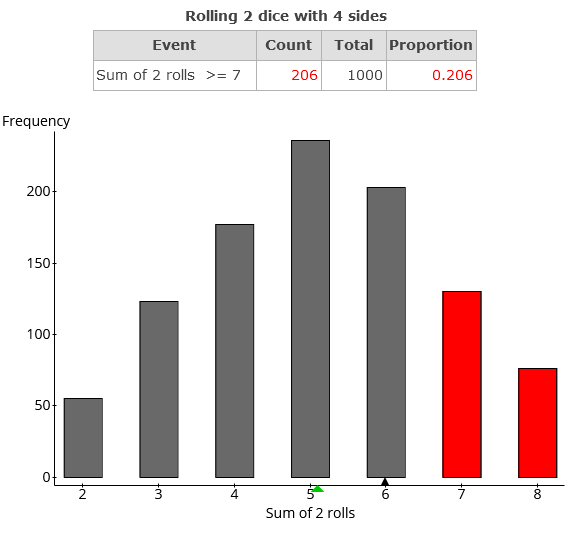
Theoretic vs empirical probability
The theoretic probability of the sum of two rolls equals to or greater than 7 is 0.1875
The empirical probability of the sum of two rolls equals to or greater than 7 is 0.206. This difference is because the first is a hypothetical result while the second is an actual experimental result
Graph- sum of two rolls is less than 7
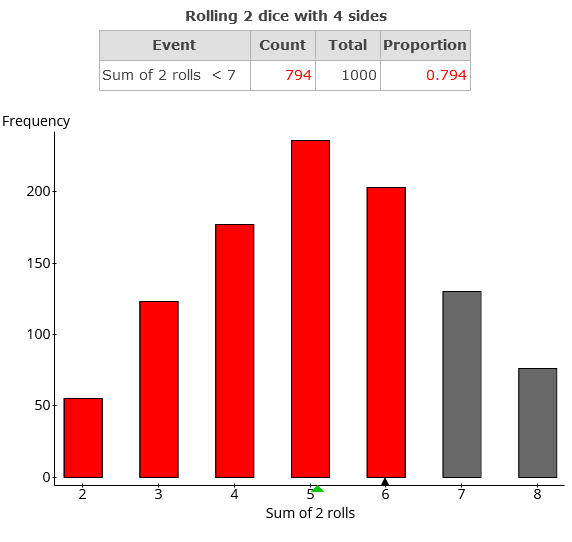
Theoretic vs empirical probability
The theoretic probability of the sum of two rolls is less than 7 is 0.8125
The empirical probability of the sum of two rolls is less than 7 is 0.794. This difference is because the first is a hypothetical result while the second is an actual experimental result
Problem 2: VW Bus Auction Sales
Histogram of winning bid
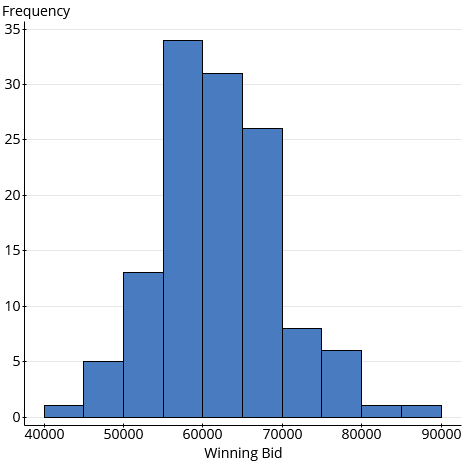
Distribution shape
The shape of the distribution is bell shaped which suggests it is a normal distribution
Proportion above 75,000
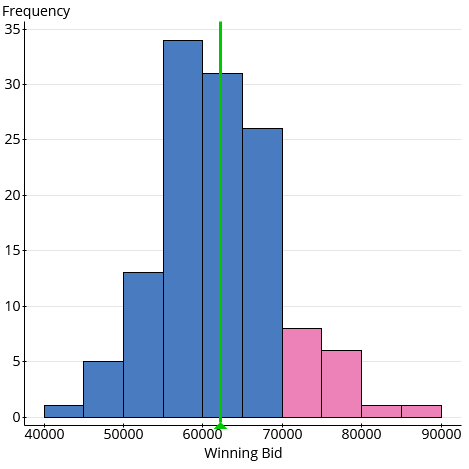
8 bids between $75,000 and $90,000
Overlay
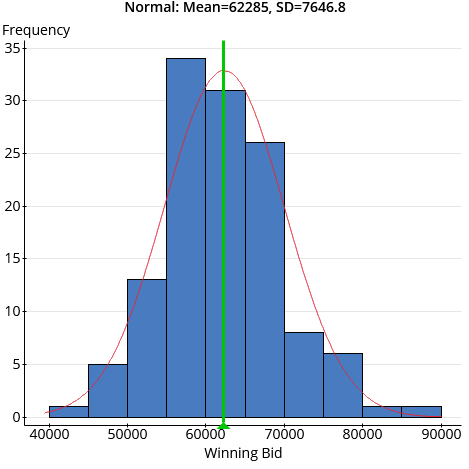
Normal probability model
It is okay to use a normal probability model in this case because the shape of the distribution, the mean and standard deviation give it the distinctive shape.
Summary statistics
| Column | n | Mean | Std. dev. |
| Winning Bid | 126 | 62285.222 | 7646.7843 |
Hand drawing
Client to do this using own hand. Draw diagram below
Verification
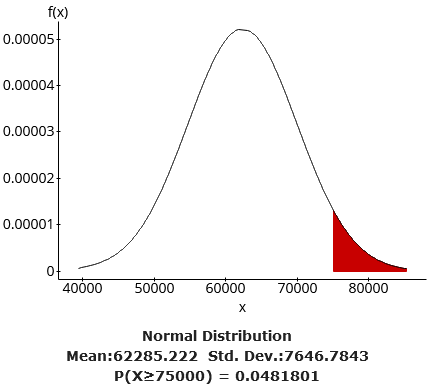
Compare this probability to the proportion
The probability and the proportion are almost equal with one being the theoretical and the other being the experimental probability
Probability diagram
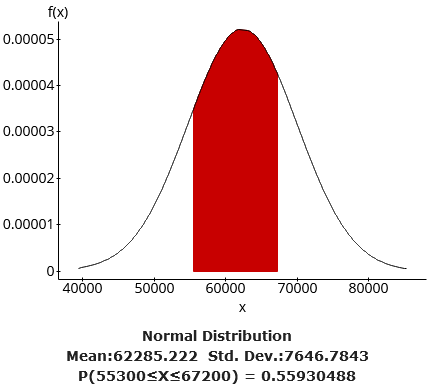
Hand diagram
Verification
Problem 3: GMU Student Voting Percentage (no data set)
Binomial experiment requirements
A binomial experiment must have n identical trials.
Each of these n trials must be independent
Each trial only has two possible outcomes e.g. Yes/ No, Success/ Failure, etc.
The probability of an outcome remains the same in each trial
Using the binomial calculator to produce probability distribution
| x | p(x,n,p) |
| 0 | 0.00000015 |
| 1 | 0.00000419 |
| 2 | 0.00005428 |
| 3 | 0.00043494 |
| 4 | 0.00241262 |
| 5 | 0.00981409 |
| 6 | 0.0302438 |
| 7 | 0.07189826 |
| 8 | 0.13294008 |
| 9 | 0.1911829 |
| 10 | 0.21209864 |
| 11 | 0.17825954 |
| 12 | 0.10986747 |
| 13 | 0.04687967 |
| 14 | 0.01238295 |
| 15 | 0.00152641 |
| 0.99999999 |
Example
At least eight voted P (8, 15, 0.649) manual calculation
| x | p(x,n,p) |
| 0 | 0.00000015 |
| 1 | 0.00000419 |
| 2 | 0.00005428 |
| 3 | 0.00043494 |
| 4 | 0.00241262 |
| 5 | 0.00981409 |
| 6 | 0.0302438 |
| 7 | 0.07189826 |
| 8 | 0.13294008 |
| 0.24780241 |
P (8, 15, 0.649) = 0.24780241
At least eight voted P (8, 15, 0.649) StatCrunch calculation
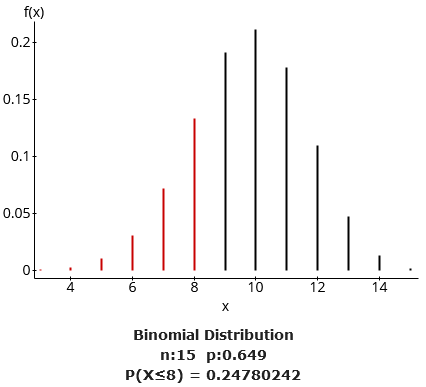
P (8, 15, 0.649) = 0.24780242
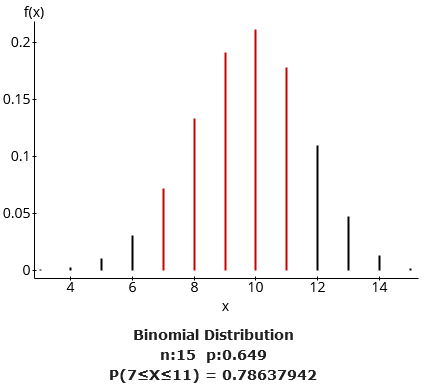
Between 7 and 11 voted P (7≤X≤11, 15, 0.649) StatCrunch calculation
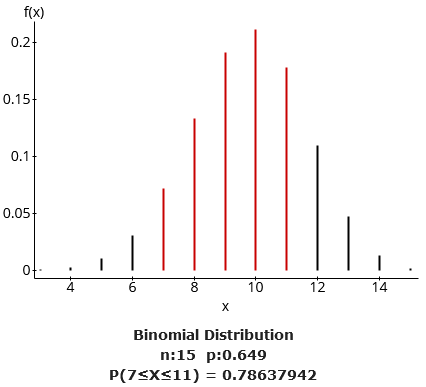
This is the probability of between 7 to 11 students voting, excluding less than 7 and more than 11.
Mean and SD
Mean of the distribution (μx) is n * P i.e. 15*0.649 = 9.735
Standard deviation (σx) is sqrt [n * P * (1 – P)] i.e. sqrt [9.735*0.351] = 1.849
Exactly 10 voted, StatCrunch calculation
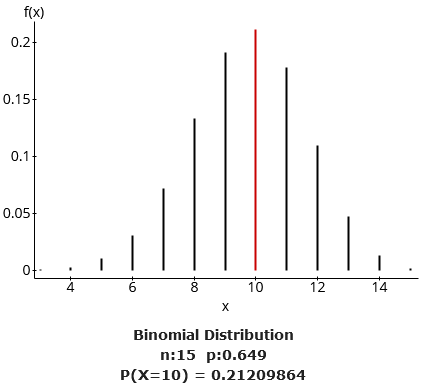
P (10, 15, 0.649) = 0.21209864
Relative frequency bar plot
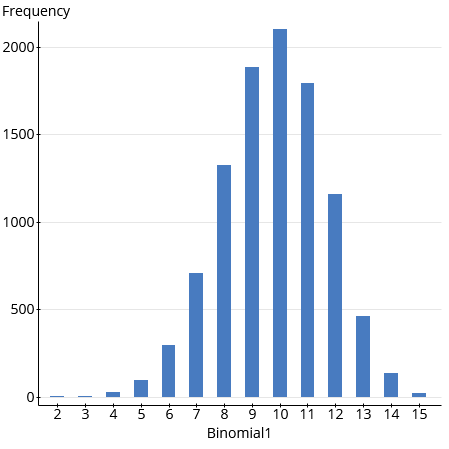
Height of bar above ten is 2104. Compared to part 3(g) where the probability was 0.21209864, the expected result would have been 2120. But the latter is a theoretical probability while the former is empirical
Problem 4: Building a Sampling Distribution (no data set)
Sampling distribution
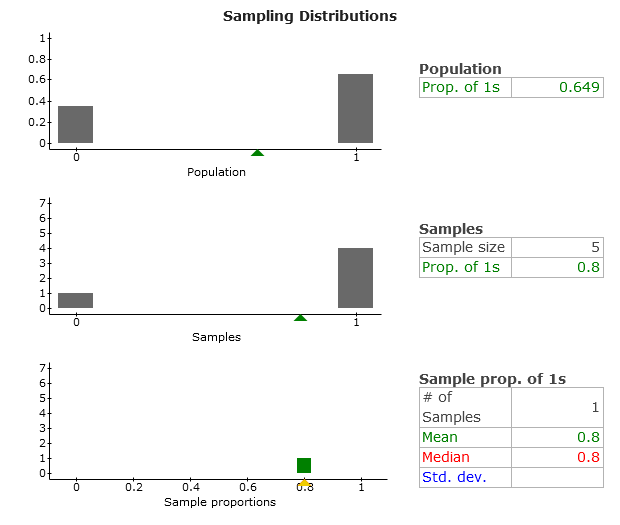
1000 samples of size 5
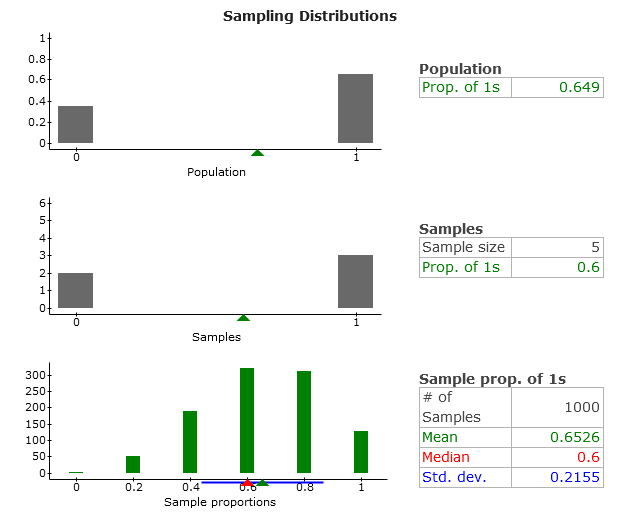
Shape of the Sample Proportions graph
The sample has a bell shaped curve which suggests it’s a normal distribution
Central Limit Theorem
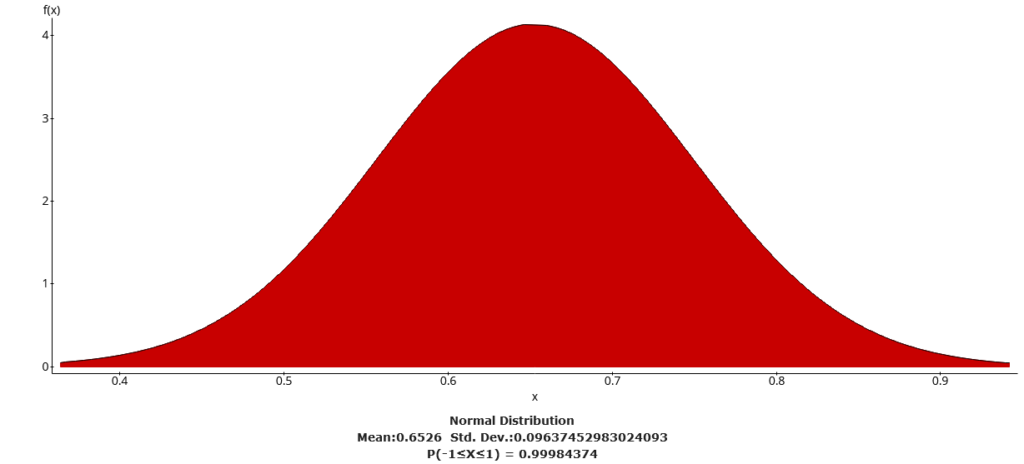
Sample size 100 for 1000 trials
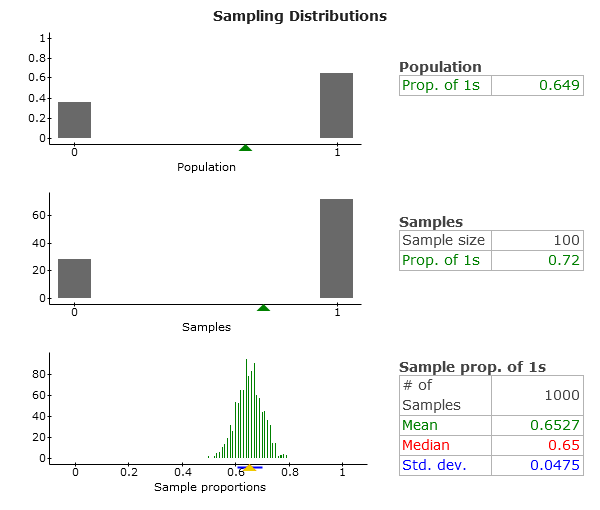
Graph description
The sample has a bell shaped curve which suggests it’s a normal distribution
Central Limit Theorem
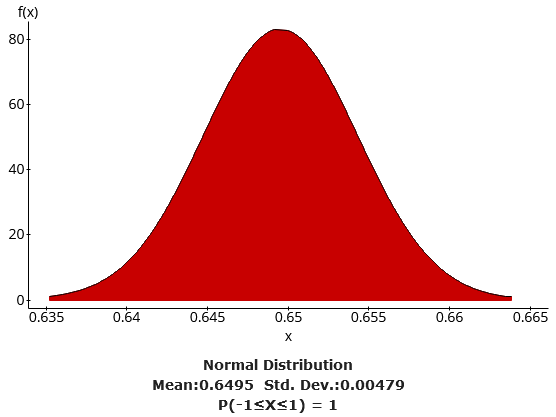
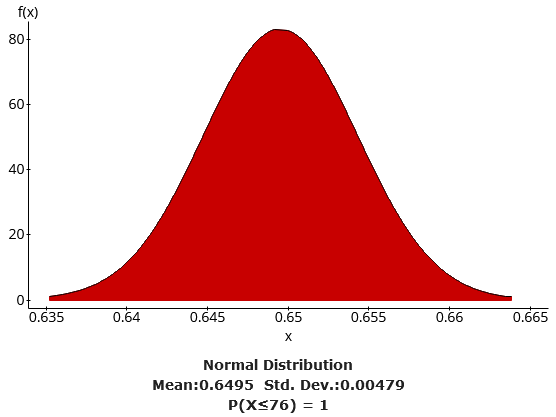
Mean – 0.6495
SD – 0.0479
Mean value vs population proportion.
The mean mimics the value proportion of the population of 100 in the sample
Standard error
SE = SD/sqrt(n) i.e. 0.0479/sqrt (100) = 0.00479
Standard error vs SD
The standard error is simply the standard deviation divided by 10 or a tenth
Hand diagram
Copy diagram below by hand
As a renowned provider of the best writing services, we have selected unique features which we offer to our customers as their guarantees that will make your user experience stress-free.
Unlike other companies, our money-back guarantee ensures the safety of our customers' money. For whatever reason, the customer may request a refund; our support team assesses the ground on which the refund is requested and processes it instantly. However, our customers are lucky as they have the least chances to experience this as we are always prepared to serve you with the best.
Plagiarism is the worst academic offense that is highly punishable by all educational institutions. It's for this reason that Peachy Tutors does not condone any plagiarism. We use advanced plagiarism detection software that ensures there are no chances of similarity on your papers.
Sometimes your professor may be a little bit stubborn and needs some changes made on your paper, or you might need some customization done. All at your service, we will work on your revision till you are satisfied with the quality of work. All for Free!
We take our client's confidentiality as our highest priority; thus, we never share our client's information with third parties. Our company uses the standard encryption technology to store data and only uses trusted payment gateways.
Anytime you order your paper with us, be assured of the paper quality. Our tutors are highly skilled in researching and writing quality content that is relevant to the paper instructions and presented professionally. This makes us the best in the industry as our tutors can handle any type of paper despite its complexity.

Recent Comments