Literature Review Assignment Instructions
Overview
The literature review assignment gives you the chance to research your topic and research question so that you can understand the scholarly context around your topic as well as the research gap that your question might help to fill.
Instructions
In 1,000-1,500 words and using at least seven scholarly sources, create a literature review of the scholarship and research gap around the topic of your research proposal.
Requirements:
Additional Suggestions:
Note: Your assignment will be checked for originality via the Turnitin plagiarism tool.
Topic And Research Question Template
Topic: Does listening to music increase dementia patient’s overall caloric intake at mealtimes?
Sample: Individuals with a current diagnosis of dementia, (may be mild to severe).
Independent Variable: Playing music prior to and during all regular mealtimes for 1 week.
Dependent Variable: Mealtime intake.
Hypothesis: Dementia patients who listen to music prior to and during mealtime, will have higher overall (food and beverage) caloric intakes.
Research Question: Will playing music “familiar” to dementia patient’s increase overall caloric and fluid intakes at mealtime?
Disciplines Incorporated: Psychology, Health Sciences and Nursing.
Justification:
Psychology: Will obviously be involved in this research as it relates to the diagnosis of dementia and the interventions related to psychology that allow us to better understand its far reaching effects on the individuals who are diagnosed with dementia as well as the family members and care givers that are directly involved in providing their care.
Health Sciences: Is involved as a broader term related to this project and is a degree that is research related to health sciences which is primarily acquired through research studies.
Nursing: Is required to be involved as an integral part of this study, as nurses are the overseers, team leaders and hands on providers of the care involved with the subjects which will be a part of this proposed research. Nurses are also directly involved in the gathering of the data required for proper analysis of this project. Nurses not only provide direct care, but they also offer support for family members and other care team members involved in the care of dementia patients.
The Impact of Music on Calorie and Fluid Intake of Patients with Dementia
The National Center for Health Statistics reported that there are approximately 15,600 long-term care facilities in the United States, housing approximately 1.4 million older adults with dementia (Namasivayam-MacDonald et al. 2018). Epidemiological studies predict that dementia patients will likely continue with the increasing number of older adults. The implication of this is that the healthcare system will face unique challenges in meeting the health needs of individuals.
As dementia advances, patients’ nutrient intake always declines. This tendency is often accompanied by malnutrition, weight loss, and increased mortality and disease morbidity (Douglas & Lawrence, 2015). Health scientists have developed various interventions to improve meal intake and reduce unintentional loss among dementia patients. Some studies have demonstrated that PWD meal intake improves when adequate assistance is delivered by informal caregivers or healthcare providers (Douglas & Lawrence, 2015). Other studies focus on the type of meal service, suggesting that buffet-and family-dining styles positively impact the nutritional intake of patients with dementia patients (Douglas & Lawrence, 2015). Environmental-related studies have reported that improving lighting and altering the dining room seating arrangement will improve the meal intake of patients with dementia (Douglas & Lawrence, 2015). Others suggest that using food aroma will stimulate their appetite and improve their meal intake (Douglas & Lawrence, 2015). This literature review aims to examine research on the influence of music in enhancing caloric and fluid intake among dementia patients.
Music positively affects an individual’s emotions, including in patients with dementia (PWD). A qualitative content analysis conducted by Gotell et al. (2007) showed that background music during morning care sessions significantly improved the expressed emotions and moods in PWD. The results showed that in the absence of background music or singing, the communication was very disjoint: the caregiver used energy and good spirit to narrate to and instruct the PWD regarding the grooming activities to be performed, and yet the PWD responded with listlessness, confusion, fear, and even aggression (Go¨tell et al., 2007). However, when background music was introduced, the communication process significantly improved. The PWD appeared to be more energized and responsive to the caregivers’ instructions. Aggression was strongly reduced, and the caregivers established a sense of reciprocity, mutual appreciation, and personal connection with their patients using background music (Go¨tell et al., 2007). This study demonstrates the promising potential of background music in improving patients’ moods and interactions with caregivers.
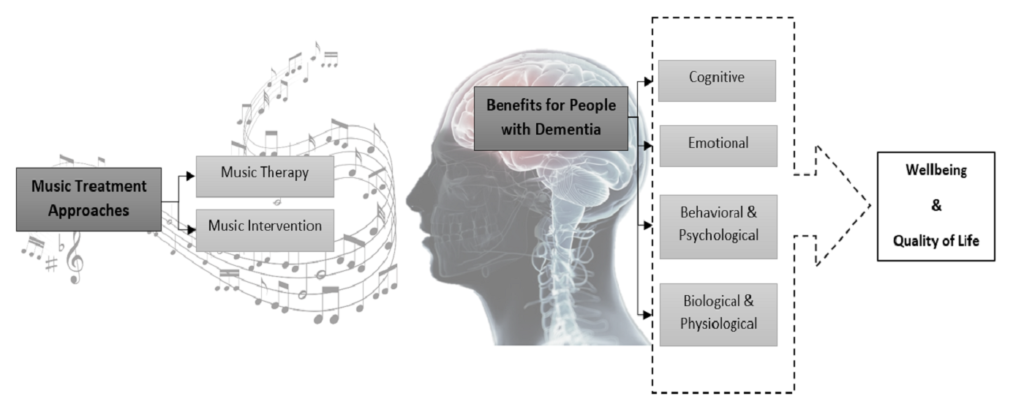
Because music improves communication and interactions between PWD and caregivers, healthcare providers can also use it to improve their nutritional intake. This statement is supported by an empirical study conducted by Wong et al. (2008). The authors investigated the impact of playing soothing music on the calorie intake of patients with dementia. The study found that playing soothing music improved patients’ caloric intake with dementia.
Another study conducted by Thomas and Smith (2009) supports Wong et al.’s (2008) findings. The authors’ study showed that playing familiar background music improved the caloric intake of PWD. The participants consumed 20% more calories when the caregivers played familiar background music during diner time (Thomas & Smith, 2009). Although this study proves that music can improve the caloric intake of PWD, it is subject to methodological issues. First, the authors had a small sample size (12 participants), meaning their findings cannot be generalized. Additionally, all the participants were selected from the same nursing home, limiting its generalizability.
A recent scoping review indicated that playing calm music could improve the mealtime experiences of PWD. According to the authors, playing background music in the residential home created a home-like atmosphere, increasing the mealtime experience of PWD (Brunner et al., 2021). This study combined music and other interventions such as lighting; hence, readers cannot isolate the observed effects to determine how music specifically contributed to PWD’s dining experiences.
The research evidence supporting this intervention is also inconsistent. Wansink and Ittersum (2012) conducted an experimental study to determine whether lighting and music influenced people to eat less food. The authors found that playing music created a relaxed environment, reducing the participants’ food consumption (Wansink & Ittersum, 2012). The finding of this study contradicts previous studies that have shown that lighting and soothing music increase food consumption.
Additionally, most of these studies concentrated on the influence of music on food/caloric intake. None of these studies have investigated how music influences fluid intake. According to Namasivayam-MacDonald et al. (2018), dehydration is a form of malnutrition characterized by extracellular and intracellular fluid depletion. Fluid intake is essential for eliminating toxins in the body and thermoregulation. The institute of medicine recommends that both men and women have an average fluid intake of 3700 mL and 2700 mL, respectively (Namasivayam-MacDonald et al., 2018). Nutritional guidelines show that 81% of a person’s water intake should come from beverages and 19% from foods (Namasivayam-MacDonald et al., 2018). Unfortunately, most dementia patients do not meet this fluid intake. According to Namasivayam-MacDonald et al. (2018)., approximately 60% of PWD are often dehydrated during hospitalization. Many reasons could cause the inadequate fluid intake observed in this population. First, many patients with dementia are older adults, meaning their kidneys’ capacity to concentrate urine is limited.
Secondly, most of these patients take medications, e.g., diuretics, which increase their fluid excretion. Thirdly, PWD may also have reduced thirst sensation. Some patients often experience difficulties or painful posture when visiting the toile; hence, they may intentionally reduce fluid intake to reduce bathroom visits (Namasivayam-MacDonald et al., 2018). Inadequate fluid intake can cause delirium, urinary tract infections, hyperthermia, constipation, kidney stones, and orthostatic hypotension, underscoring the importance of improving fluid intake in this population. Interventions to improve fluid intake in this population are many. However, to the best of my knowledge, no study has investigated the effect of music on fluid intake of PWD. This study will contribute to the literature by generating knowledge on the impact of music on calorie and fluid intake of dementia patients.
Conclusion
This literature review has explored research on the influence of music in enhancing the caloric intake of dementia patients. There seems to be evidence that music positively influences the caloric intake of patients with dementia. Studies suggest that soothing background music reduces agitation and creates a relaxing atmosphere, causing dementia patients to consume more food. However, some studies have methodological issues, including having a small sample and a lack of randomization. Without randomization, researchers cannot be certain that the observed effect resulted from the intervention. The findings on this subject are inconsistent. Some studies show that soothing music reduces caloric intake, while others report increasing calorie intake. Also, to the best of my knowledge, no study has investigated the effect of music on fluid intake among dementia patients. These research gaps highlight the need to investigate the impact of familiar background music on overall caloric and fluid intake at mealtime in dementia patients.
References
Brunner, S., Mayer, H., Qin, H., Breidert, M., Dietrich, M., & Müller Staub, M. (2021). Interventions to optimise nutrition in older people in hospitals and long‐term care: Umbrella review. Scandinavian Journal of Caring Sciences, 99. https://doi.org/10.1111/scs.13015
Douglas, J. W., & Lawrence, J. C. (2015). Environmental considerations for improving nutritional status in older adults with dementia: A narrative review. Journal of the Academy of Nutrition and Dietetics, 115(11), 1815–1831. https://doi.org/10.1016/j.jand.2015.06.376
Namasivayam-MacDonald, A. M., Slaughter, S. E., Morrison, J., Steele, C. M., Carrier, N., Lengyel, C., & Keller, H. H. (2018). Inadequate fluid intake in long term care residents: prevalence and determinants. Geriatric nursing, 39(3), 330-335. https://www.sciencedirect.com/science/article/pii/S0197457217303026
Thomas, D. W., & Smith, M. (2009). The effect of music on caloric consumption among nursing home residents with dementia of the Alzheimer’s type. Activities, Adaptation & Aging, 33(1), 1–16. https://doi.org/10.1080/01924780902718566
Wong, A., Burford, S., Wyles, C. L., Mundy, H., & Sainsbury, R. (2008). Evaluation of strategies to improve nutrition in people with dementia in an assessment unit. The Journal of Nutrition Health and Aging, 12(5), 309–312. https://link.springer.com/article/10.1007/BF02982660
As a renowned provider of the best writing services, we have selected unique features which we offer to our customers as their guarantees that will make your user experience stress-free.
Unlike other companies, our money-back guarantee ensures the safety of our customers' money. For whatever reason, the customer may request a refund; our support team assesses the ground on which the refund is requested and processes it instantly. However, our customers are lucky as they have the least chances to experience this as we are always prepared to serve you with the best.
Plagiarism is the worst academic offense that is highly punishable by all educational institutions. It's for this reason that Peachy Tutors does not condone any plagiarism. We use advanced plagiarism detection software that ensures there are no chances of similarity on your papers.
Sometimes your professor may be a little bit stubborn and needs some changes made on your paper, or you might need some customization done. All at your service, we will work on your revision till you are satisfied with the quality of work. All for Free!
We take our client's confidentiality as our highest priority; thus, we never share our client's information with third parties. Our company uses the standard encryption technology to store data and only uses trusted payment gateways.
Anytime you order your paper with us, be assured of the paper quality. Our tutors are highly skilled in researching and writing quality content that is relevant to the paper instructions and presented professionally. This makes us the best in the industry as our tutors can handle any type of paper despite its complexity.

Recent Comments