Scenario
You are a department manager for a distribution team that packages and ships products from a warehouse location to fulfill customer orders. Your company has been acquired by a larger firm. The new owners are requesting that each department manager prepare a master budget for the upcoming year and submit it for approval. The submission must include a written justification of the requested amount and at least one risk mitigation action to control or reduce costs.
The information available to meet this request includes:
The department’s expenses, staffing, and output for the past 12 months;
Metrics, financial and operational, that can be used to compare the department’s performance and output to a department that provides similar distribution support to another division of the company;
One potential efficiency project with two available financing options;
Data on the company’s historic employee practices such as annual raises and bonuses; and
The level of output that the department must meet in the upcoming year based on the new owners’ sales goals.
Instructions
Using the information provided, as well as relevant economic data researched independently, make decisions about:
The staffing level required to meet the expected output requirements;
The annual raises and bonuses that should be included in the budget;
Whether the efficiency project option should be implemented, and if so, using which financing option; and
The cost control (i.e. risk mitigation) action(s) for implementation.
From your decisions, prepare a master budget for the upcoming year in Excel. Then, prepare a written justification, memo-style, for the budget that discusses your decisions and the rationale for each. Include support for your decisions from your analysis of the data and the financial and operational metrics (historical and expected) as well as at least one external economic or industry source.
In the justification memo, include one visual (chart, graph, etc.) created from the data. The purpose and type of visual selected should be based on the data being highlighted. Examples include a summary pie chart of the total budget, a bar chart comparing the department’s historical metrics to the expected metrics with the new budget, or costs across time to implement the efficiency project using the recommended financing options.
Submit an Excel file with the new master budget and a justification memo with embedded visual.
Financial Analysis for Master Budget Planning, Excel and Memo
To: CEO
From: Department Manager
Date: 19 May 2022
Subject: Budget Justification and Risk Mitigation Action
The department has developed an effective logistics and shipping strategy to ensure the attainment of greater results for the company in the coming year. Apparently, logistics can spell the difference between success and failure in the business (Carbone, Rouquet, & Roussat, 2017). For this reason, the included budget is meant to achieve logistical efficiency and a greater level of success for the company. This memo provides the justification for the budget that has been developed to support this strategy. The justification is based on the department’s expenses, staffing, and output for the past 12 months. It has been based on the metrics, financial and operational comparisons of the department’s performance, and output to similar departments that provide the industry’s distribution services. It covers aspects of warehouse operations as well as warehouse general and administrative expenses. Besides, the risk mitigation action to control or reduce costs in the new financial year has been included.
Table 1: Warehouse operations
| Warehouse Operations | ||
| Warehouse Operations Personnel | ||
| Category | Annual estimates | Level of effort |
| Receiving Team | ||
| Employee Wages Including Overtime | 121,574.25 | 5% increase |
| Employee Bonus and Benefit Programs | 32,825.05 | 5% increase |
| Stocking Team | ||
| Employee Wages Including Overtime | 265,240.60 | 5% increase |
| Employee Bonus and Benefit Programs | 71,614.96 | 5% increase |
| Receiving and Stocking Operations | 491,254.86 | |
| Picking Team | ||
| Employee Wages Including Overtime | 373,327.50 | 5% increase |
| Employee Bonus and Benefit Programs | 100,798.43 | 5% increase |
| Packing Team | ||
| Employee Wages Including Overtime | 691,437.60 | 5% increase |
| Employee Bonus and Benefit Programs | 186,688.15 | 5% increase |
| Picking and Packing Operations | 1,352,251.68 | |
| Total Warehouse Operations Personnel Budget | 1,843,506.54 | |
JUSTIFICATION: The names of the team members have been described in the staffing worksheet. At the same time, the Packing, receiving, stocking, and picking team lead would provide daily oversight of the warehouse operations and the teams working under them.
Table 2: Warehouse general and administrative expenses
| Categories | Cost |
| Rent | 240,000.00 |
| Insurance | 80,000.00 |
| Repairs and Maintenance | – |
| Utilities | 22,080.00 |
| Licenses and Fees | 12,000.00 |
| Administrative and Management Salaries | 374,200.00 |
| Employee Bonus and Benefit Programs | 139,344.00 |
| Miscellaneous | – |
| Shrinkage | 382,173.00 |
| Supplies – Office | – |
| Total Expenses | 1,249,797.00 |
JUSTIFICATION: The warehouse general and administrative expenses remain fixed in the new year, considering that the warehouse still has capacity for an additional 50% growth in volume. In this case, no new expenses would be incurred in this area as the team strives to increase operations to meet the higher volume demands.
The staff worksheets have been evaluated to guarantee optimal performance in the coming year. Steps that have been taken to mitigate risks associated with loss of money include:
Mitigation measures and risk controls have been envisaged in an attempt to achieve the objectives set out in the budget for the New Year. The secret to this envisioning is to gather all the relevant data and focus beyond the current state of play. This vision is set out in Table 3 and involves both final-state distribution personnel and interim needs.
Table 3: Envisioning distribution needs
| Distribution Operations | Prior Year Values | New Year Targets | Comments |
| Cases of Goods Received in Dock | 320,000 | 400,000 | Increase in warehouse activity based on expected increase in customer orders |
| Customer Orders Shipped | 751,000 | 939,000 | Expecting a 25% increase in customer orders due to new products and expansion |
| Average Inventory Value per Order | $ 18.50 | $ 20.35 | Expecting a 10% increase in value of customer orders due to pricing changes and order size |
| Average Supply Cost per Order | $ 1.50 | $ 1.65 | Expecting a 10% increase in cost of boxes and other packing supplies due to order size |
| Average Shipping Cost per Order | $ 8.00 | $ 8.64 | Expecting an 8% increase in cost of shipping customer orders due to order size and vendor fee inflation |
| Performance Targets | Prior Year Values | New Year Targets | Comments |
| Receiving and Stocking Cost (Average Cost per Case) |
$ 1.34 | $ 1.32 | Company executives have set a target of 1% reduction in average cost |
| Picking and Packing Cost (Average Cost per Order) |
$ 1.74 | $ 1.73 | Company executives have set a target of 1% reduction in average cost |
| Receiving and Stocking Cost (Average Cost per Case) |
$ 1.33 | New year estimated value based on new budget and new target volumes | |
| Picking and Packing Cost (Average Cost per Order) |
$ 1.48 | New year estimated value based on new budget and new target volumes |
Staffing plans can be the first step in the organization’s evolution towards the adoption of workforce planning. As leaders are becoming more satisfied with iterative head-to-head planning, the additional complexity in terms of criteria, timeframes, or scenarios may be implemented to improve team discussions and long-term strategic plans. This document’s shared details demonstrate the wider scope of the department’s work to ensure that organizations can enhance their shipping and distribution business, as shown in figure 1 below. In fact, the average costs for the two years remain relatively the same as demonstrated in figure 2.

Figure 1: Distribution operations
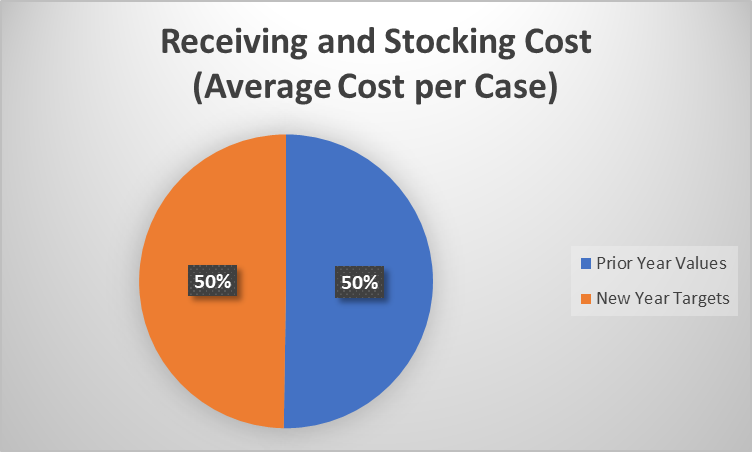
Figure 2: Average receiving and stocking costs for prior year and New Year targets
Carbone, V., Rouquet, A., & Roussat, C. (2017). The rise of crowd logistics: a new way to co‐create logistics value. Journal of Business Logistics, 38(4), 238-252. https://www.researchgate.net/publication/319325907_The_Rise_of_Crowd_Logistics_A_New_Way_to_Co-Create_Logistics_Value
Fonseca, G. L., Anunciação, P. F., & Penalver, A. J. B. (2019). The Role of Dynamic Capabilities as Influencers of Organizational Intelligence. In Handbook of Research on Business Models in Modern Competitive Scenarios (pp. 138-149). IGI Global.
Rastogi, A., Pati, S. P., Krishnan, T. N., & Krishnan, S. (2018). Causes, contingencies, and consequences of disengagement at work: An integrative literature review. Human Resource Development Review, 17(1), 62-94. https://journals.sagepub.com/doi/abs/10.1177/1534484317754160
Shafagatova, A., & Van Looy, A. (2020). Alignment patterns for process-oriented appraisals and rewards: using HRM for BPM capability building. Business Process Management Journal. https://www.emerald.com/insight/content/doi/10.1108/BPMJ-03-2020-0101/full/html
As a renowned provider of the best writing services, we have selected unique features which we offer to our customers as their guarantees that will make your user experience stress-free.
Unlike other companies, our money-back guarantee ensures the safety of our customers' money. For whatever reason, the customer may request a refund; our support team assesses the ground on which the refund is requested and processes it instantly. However, our customers are lucky as they have the least chances to experience this as we are always prepared to serve you with the best.
Plagiarism is the worst academic offense that is highly punishable by all educational institutions. It's for this reason that Peachy Tutors does not condone any plagiarism. We use advanced plagiarism detection software that ensures there are no chances of similarity on your papers.
Sometimes your professor may be a little bit stubborn and needs some changes made on your paper, or you might need some customization done. All at your service, we will work on your revision till you are satisfied with the quality of work. All for Free!
We take our client's confidentiality as our highest priority; thus, we never share our client's information with third parties. Our company uses the standard encryption technology to store data and only uses trusted payment gateways.
Anytime you order your paper with us, be assured of the paper quality. Our tutors are highly skilled in researching and writing quality content that is relevant to the paper instructions and presented professionally. This makes us the best in the industry as our tutors can handle any type of paper despite its complexity.

Recent Comments