This competency assessment assesses the following Outcome:
MT460M2-2: Use a variety of analytical tools to monitor and improve business strategy.
In this assessment, you will address one Course Outcome by conducting a business case study analysis.
You will find the following resource to be a helpful guide in your analysis of your chosen case study: Guide to Case Analysis. This assessment will require intensive interpretation skills. Be sure to read this Case Analysis Guide to prepare. Use the following criteria to evaluate the external (Part 1) and internal (Part 2) environment of your chosen company:
Scenario:
You will evaluate the “Award Application Summary” as a business case. You are the director of strategy and business intelligence for your chosen company. You are conducting an evaluation of your chosen company for an upcoming annual report. Your goal is to demonstrate skill and expertise in strategic analysis of the strategic position of your company. You will be submitting this report to the other C-level executives for consideration. Use the following criteria to make strategic decisions for your chosen award-winning organization.
Assessment Part 1 Requirements:
Assessment Part 2 Requirements:
Business Strategy Analysis: Marriott International
Part 1
Marriott International is a company that operates in the hotel industry. Furthermore, Marriott International is a multinational company located in the United States and manages hotel franchises, portfolio hotels, and lodgings. Marriott is the largest hotel chain according to the number of rooms; it also owns 30 brands that are spread in 131 countries worldwide. Moreover, by June 2020, the company owned 1,400,693 rooms worldwide (Olawale, 2020). Apart from the company’s accommodation services, it is also known to be the world’s first hotel to offer its customers food that is Trans fat-free. When it comes to the target market, the company targets business people and travelers who work in the business industry and thus travel a lot.
Strategy analysis is researching an organization, especially the external environment, through the PESTEL analysis to understand the environment within which a company operates. In chapter three, Thompson presents several tools for strategic analysis of a business. Some of the tools include assessing the company’s competitive power and identifying a company’s resources and capabilities (Thompson, 2019). An evaluation of these tools can help Marriott International understand its capabilities and the resources it requires to operate effectively in the future.
Macro-environment is a business’s surrounding within the economy and the forces affecting the economy. Several forces affect the macro-environment, for example, economic pressures, demographic forces, and political forces. To effectively analyze the macro-environment, it is essential to assess all the forces affecting the economy. The macro-environment is necessary for strategy development because it helps understand the economy’s situation and how it may affect the performance of a business.
| Component | Description |
| Political | Marriott International is a multinational company, and political stability and uncertainty in the United States and other countries in which the company operates can negatively impact its performances. Some of the political factors include trade policies, fiscal policies, and the level of corruption. |
| Social | The social factor is related to the COVI-19 pandemic that has negatively affected the company’s performance and is likely to affect the company goals and objectives in the future. Additional factors under this component include population, the health of people, and savings rate. |
| Technological | On the other hand, technology is a factor that will most likely affect the company’s future direction as more people hold meetings and conduct business transactions online. Factors under this component include internet connectivity and automation of services. |
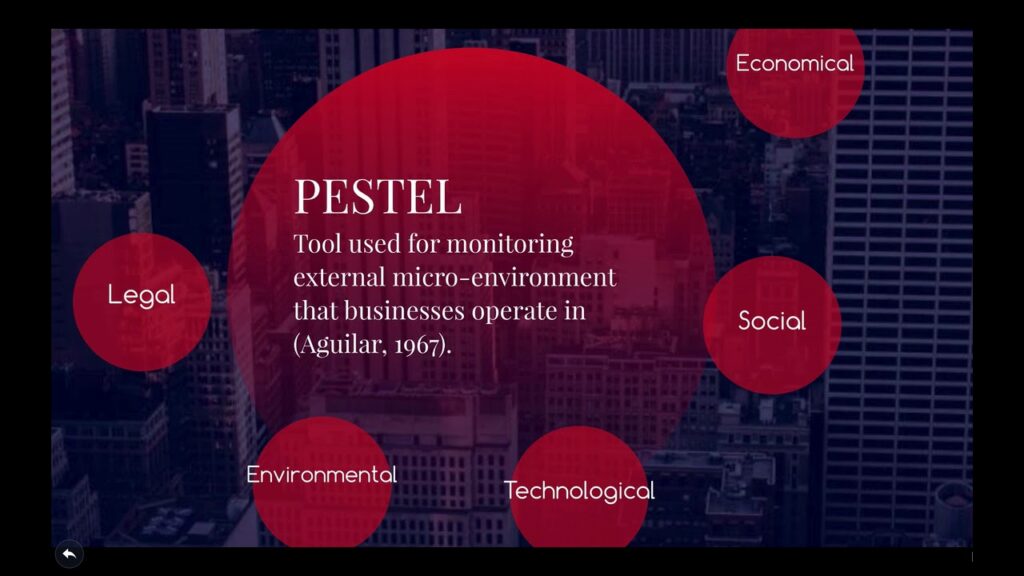
Social and technological factors are more likely to affect the company’s objective and directions compared to the political factors whose effects are limited and less likely to happen, especially in developed countries.
The five forces framework helps understand the ability of an organization to succeed in an industry. These five forces include competition, availability of substitute products, buyers’ bargaining power, supplier bargaining power, and potential entrants. An increase in all these five forces negatively affects a company’s competitive conditions, and when they are low, the competitive conditions are high. Additionally, analyzing the hotel and industry that Marriott International operates in, the analysis indicates the rate of the five forces is high. Therefore, the competitive condition of the company is negatively affected.
Taking the rivalry among competing firms into consideration, customers’ cost to switch between brands is low, which increases competition. Additionally, the services and products offered in the hotel industry are weakly differentiated, hence increasing competition. The competitive pressure of new entrants, on the other hand, is also high as companies are forced to invest in advertisements to maintain their position in the industry. When it comes to the hotel industry, accommodation and food are the main products offered. The main factors to consider when it comes to substitutes are the availability of substitutes in the industry and the low cost of switching between substitutes.
Factors affecting the bargaining power of suppliers include high demand for products offered by suppliers to companies. For example, a supplier may offer high-quality materials to the market, making them the most ordered by companies. Similarly, the high cost involved in moving from one supplier to another increases suppliers’ bargaining power. When it comes to buyers’ bargaining power, several factors affect this force, for example, the ability to postpone purchases and bookings. Additionally, a large number of buyers and a few suppliers increases the bargaining power of buyers.
SOAR framework is an essential tool for the analysis of competitors and how best to mitigate competition. The framework will help Marriott International understand the strategies, objectives, assumptions, and resources, and capabilities of its competitors in the industry. Once the company has accessed these insights, it will design and implement the most effective measures against the competition. Marriott international faces stiff competition in the industry, and the SOAR framework can help the company to mitigate competition challenges.
Part 2
The first financial ratio is the gross profit margin calculated as the cost of goods sold subtracted from sales revenue and then divided by sales revenue. This ratio indicates the percentage of revenue available for the company to cover its expenses and make a profit (Thompson, 2019). Once Marriott International identifies its revenue percentages and financial position, it can adjust its operations accordingly to avoid losses. Return on sales is another ratio that indicates an organization’s operations without focusing on income taxes and interest charges. Marriott International can analyze these ratios to determine its operational efficiency. A high return on sales will indicate growth in the company while decreasing sales could indicate potential financial challenges. Net profit margin is a ratio that shows the profits that an organization generates after taxes. The ratio can help Marriott International determine if the company is making enough profits and make the necessary changes.
The main benefit of conducting a SWOT analysis is that the company can identify whether a strategy implemented within an organization is successful. This tool provides insight into the organization’s overall situation by identifying the strengths, weaknesses, opportunities, and threats in an organization. SWOT analysis is designed to improve the performance of a company.
After conducting the SWOT analysis of Marriott International, the identified company strengths include a strong global presence. The company owns about 30 brands that are located in more than 131 countries all over the world. This strength increases the company’s revenue and also spreads its risks. Similarly, market leadership is another strength the company enjoys. Marriott International is the largest company in the hotel industry regarding the number of rooms available and properties. The company has 6,500 properties with 1.2 million rooms all over the world. This strength ensures the company can enjoy economies of scale (Takacs & Vaduva, 2017). The analysis identified several weaknesses, for example, inadequate data security. In 2018, Marriott’s Starwood suffered a data breach that led to the exposure of personal information belonging to over 500 million customers; this negatively affected customers’ trust in the company. Another weakness identified at the company is civil lawsuits that affect the company’s brand and image. The company has been fined $600,000 for blocking the personal wifi of its customers (Olawale, 2020).
The SWOT analysis also identified opportunities for the company, for example, expansion into related sectors like the tourism industry. This sector is an opportunity the company can take advantage of to increase its revenue. The company can also offer houses for rent like Airbnb. Additionally, expansion into emerging markets is an opportunity the company can take up. In developing countries, the demand for high-end hospitality services is gaining popularity. When it comes to identified threats, the COVID-19 comes top as this pandemic has already affected 92% of its profits and is most likely to continue affecting its operations. Another threat is the stiff competition available in the hospitality industry. Companies like Hilton and Novotel are giving Marriott International a run for its money.
The company can turn the SWOT analysis results into strategic action by reinforcing the strength and finding the necessary resources to take advantage of the available opportunities. Furthermore, the company needs to put measures to ensure that weaknesses are mitigated and handle the threats.
The value chain activities are necessary for ensuring companies achieve their objective. When all the primary value chain activities are carried out cost-effectively, it is likely to positively impact the final cost of a total that the company will charge consumers. Marriott International has extensive brand awareness in over 131 countries that provide the company with an advantage over its rivals. Additionally, the company is a market leader with over 1.2 million rooms; hence it can enjoy economies of scale, which is a competitive advantage over its rivals in the industry.
The major strategic issue and problem that require managerial attention at the company is the COVID-19 pandemic. This pandemic has adversely affected the financial and operational performance of the company. Therefore, company management needs to develop new strategies to improve the company’s situation. Another strategic problem that requires the immediate attention of management is the declining reputation of the company. The success of Marriott International is based on its reputation, and another data breach is likely to affect further the already destroyed reputation of the company.
After conducting the strategy analysis, the results indicated the company could compete effectively with most of its rivals in the industry. Its large number of outlets and provides the company with an increased source of revenue. Additionally, the large number of rooms gives the company economies of scale that the rival may find it challenging to match. This information can help managers determine their new investment plans. By understanding their strengths and available opportunities, managers can also come up with the most efficient ways of ensuring the opportunities are exploited to the organization’s advantage.
References
Olawale, S. (2020). The Competitive Position of Marriott International Inc. and Starwood Worldwide. An Assessment using Porter’s Five Forces and PESTLE-Analysis. GRIN Verlag.
TAKACS, J., & VADUVA, S. A. (2017). Swot analysis of the global hospitality industry. Revista Economica, 69(6). https://www.researchgate.net/publication/340739678_A_SWOT_analysis_of_the_global_hospitality_industry
Thompson, A. (2019). Crafting & Executing Strategy: The Quest for Competitive Advantage: Concepts and Cases.
As a renowned provider of the best writing services, we have selected unique features which we offer to our customers as their guarantees that will make your user experience stress-free.
Unlike other companies, our money-back guarantee ensures the safety of our customers' money. For whatever reason, the customer may request a refund; our support team assesses the ground on which the refund is requested and processes it instantly. However, our customers are lucky as they have the least chances to experience this as we are always prepared to serve you with the best.
Plagiarism is the worst academic offense that is highly punishable by all educational institutions. It's for this reason that Peachy Tutors does not condone any plagiarism. We use advanced plagiarism detection software that ensures there are no chances of similarity on your papers.
Sometimes your professor may be a little bit stubborn and needs some changes made on your paper, or you might need some customization done. All at your service, we will work on your revision till you are satisfied with the quality of work. All for Free!
We take our client's confidentiality as our highest priority; thus, we never share our client's information with third parties. Our company uses the standard encryption technology to store data and only uses trusted payment gateways.
Anytime you order your paper with us, be assured of the paper quality. Our tutors are highly skilled in researching and writing quality content that is relevant to the paper instructions and presented professionally. This makes us the best in the industry as our tutors can handle any type of paper despite its complexity.

Recent Comments