COMPANY SELECTION
Texas instruments will be my company of interest in this paper. The reason for choosing this company is because of its diverse operations that cover a wide range of different countries across the globe extending to 30 countries and more than 30 000 employees. Texas instruments was founded in 1930 as an oil and gas company. It was established with a Texas-born determination to ask, “What if” – the main goal being to answer this question with ideas that open new markets and avenues of innovation.
On personal level I am an employee of this company so it will help me understand more about its financial performance and reporting that it does since I am not in the finance nor the accounting department but as a shareholder.
On business perspective, it will help me understand a wide variety client which the company deals with and how they have been able to maintain a mutual and strong relationship over the years that it has been in business.
On a professional standpoint, employing the skills of this subject I will be able to comprehend how it complies its financial reports which I believe will give me enough experience to understand this subject in deeper lengths to succeed.
FINANCIAL CONTEXT:
KEY GOODS AND SERVICES
Texas instruments revolves around engineering, manufacturing, testing, and selling of analog and embedded semiconductor chips. The company produces more than 80,000 products which serves more than 100,00 customers across the globe. The company has core values which are integrity, innovation and commitment which have remained the same to date. The company’s competitive advantages that makes it successful in the market are:
The manufacturing and technology that Texas instruments uses gives it products 30 years plus of life span and this is what differentiates them from other players in the market.
Its also benefits from their 300-millimeter wafer size manufacturing which gives it more chips per wafer with a 40% cost advantage compared to the 200-millimeter wafers sizes. They also manufacture in-house and outsource because of the inherent advantage of 300-millimeter.
FINANCIAL CONTEXT:
ORGANIZED
Texas instruments has a belief that is powered by its capital management strategy that free cash flow is most important to maximizing value over the long term and that the free cash flow will be valued only if it is productively reinvested back o the business or returned to its owners. According to its investors overview publication, the company has been able to maintain a solid cash flow margin. For example, in its financial reporting in 2018 it was able to convert 38.4% of revenue into free cash flow placing it in the top ten percent of companies in the S&P 500.
The free cash flow per share has been recorded to be steady over the past ten years despite threats of macroeconomics and market environments challenges. There has also been 15 years of consecutive dividend increase.
The company’s financial reporting includes non-GAAP reports which are discussions of free cash flow and various ratios based on that measure in order to provide insight into their liquidity and the amount of cash potentially is available to return to the shareholders. The non-GAAP reports are only supplemental to the comparable GAAP measures. The company also prepares financial statements in accordance to GAAP and SEC.
References
Introduction
Financial performance measures the ability of firms to utilize their assets to generate revenue. The financial health of a firm, on the other hand, refers to the state of the firm’s monetary affairs. These elements are essential in the growth and development of the companies. The evaluation of a company’s financial performance and health can be done through a thorough analysis of the company’s financial statements (Pamela Peterson Drake, 2012). Financial statements record and convey business activities that indicate its performance as a company and in the industry. These financial statements include balance sheets, income statements, and cash flow statements. Financial statement analysis aids a company’s decision-making concerning substantial aspects that relate to the success and health financial states. Texas Instruments Incorporated forms the basis for this financial analysis of its financial statements through horizontal analysis of year-to-year comparison.
Organizational Context
Texas Instruments Incorporated is a public, global, and American company in the semiconductor industry founded in 1930 with its headquarters in Dallas, Texas. The company designs and manufactures semiconductors and integrated circuits in addition to the development of analog chips and embedded processors. The company’s products and services are categorized into two distinct segments, namely the analog, and embedded processing. In these segments, over 80,000 products have been manufactured, serving over 30 countries and 100,000 customers globally. In the analog segment, the product line includes products such as HVAL, power management, HPA, and SVA (Reuters, 2020). HVAL products support safety and automotive devices. The embedded product line includes processors, connectivity, and microcontrollers, mainly digital signal processors and application processors. The company serves over 100,000 customers in the world and enjoys over 40,000 patents showing how prominent the company is regarding technological advancements and innovations.
The success and high financial performance result from the company’s competitive advantage strategies, among other aspects of the company. The strong foundation in manufacturing and the incorporation of differentiated technologies enhances its product portfolio. In addition, the diversity and longevity of its products, customer positions, and markets become substantial sources of sustainable competitive advantage. The operations and products of TI have huge impacts on the company’s decision-making process, including its global presence, and customer needs. The impact results in the company setting boundaries for effective decision-making and financial performance. Primarily, TI employs a functional organizational structure with each executive responsible for different departments of the organization (Kasimov, 2013). The heads make decisions of the departments hence making decision-making quick and rigid. Through the structure, employees can communicate freely, and the executives or leaders facilitate open communication. Decisions can be limited to the company’s location, and customers depending on customer needs, unique and differentiating customer features, and wants. The unique aspects of markets and customers establish boundaries in decision-making for the company.
The differences in customer needs and market trends based on the geographical difference limits and enhances the company’s decisions, which profoundly affect its financial information and accounting (TI, 2020). The difference translates into different revenue and sales in the locations, as some locations may experience high sales due to high consumer needs while others may lag. In addition, the industry suffers stiff competition in the wake of advanced and differentiated technologies, which requires the company to differentiate its products or develop newer products for its extensive customer base. TI requires standardized performance in the different geographic locations ensuring decision-making is alike and identical while considering the unique market trends and customer wants. Setting boundaries in decision-making has both limitations and benefits for the company, standardizing, and decision customization; however, would help the company maximize the benefits and limit the costs and threats.
Financial Performance
A company’s income statement conveys its profits and losses, showing its ability to generate sales and revenues while maximizing profits and minimizing the expenses and damages. According to TI’s consolidated income statement over the fiscal years of 2018, 2017, and 2016, the company’s financial performance analysis can be achieved. Over the past three financial years of TI, the company has had ‘shaky’ performance in terms of its revenue. In 2017, TI’s revenue increased by 12% and in 2018 by 6%. The 6% increase was due to the rise in the sales and revenue of the Analog product line segment (TI, 2019). Moreover, the gross profit of the company in 2018 increased by 7% due to lowered operating and manufacturing costs. This resulted in increased operating income by 7%, which is 42.5% of the total revenue and an increment of 1.8% from 40.7% of revenue in 2017. It is the same as the increment in 2016, whereby 12% was from increased revenues from both product segments.
| In Millions | 2016 | 2017 | 2018 |
| Revenue | $13,370 | $14,961 +12% | $15,784 +6% |
| Operating income | $4,855 | $6,083 | $6,713 |
| Net income | $3,595 | $3,682 +2% | $5,580 +51% |
| EBIDTA | $3,595 | $3,741 | $5,535 |
This shows the growth of Texas Instruments year to year due to its increased sales in its product line segments, increased segment performance, and the decrease in tax provisions due to the enactment of the Tax Act in 2017, among other reasons. Most notably, the net income of the company seems to be increasing year to year with a 2% increment in 2017 and a 51% increment in 2018. This continuous increment of the net income reflects high financial performance and a healthy financial status for TI (TI, 2019). This can be attributed to the increasing revenues in the product line segments and increases gross profit in the company. The items that stand out in the company’s income statement is the continuous growth in the net income with a positive performance in 2018 by a rather high value of 51%.
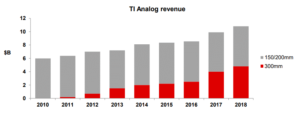
(TI, 2019)
The cash flow of a company shows the inflows and outflows whereby the money coming in is from the sales, customers, accounts receivable, and investments. On the other hand, the money coming out includes the expenses, loans and debts, taxes, and accounts payable.
| In Millions | 2016 | 2017 | 2018 |
| Cash from OA | $4,614 | $5,363 | $7,189 |
| Cash from investing | $(650) | $(1,127) | $(78) |
| Cash from financing | $(3,810) | $(3,734) | $(6,329) |
| Free cash flow | $4,083 | $4,668 | $6,058 |
| Cash & cash equivalent (end) | $1,154 | $1,656 | $2,438 |
The consolidated cash flow data outlines TI’s cash flow management of its inflows and outflows. The cash from operating activities increases over the years form $4,614 in 2016 to $5,363, a 16% increment, to $7,189 in 2018, a 36% increment. This conforms to an increase in the capital expenditure in cash from investing in 2017 but decreases in 2018. The decrease shows the fall in money spent in the company. The cash from financing activities is all-negative over the three years, which includes cash used to pay investors, changing loans, and even issuing more stocks (TI, 2019). This analysis helps the company reconcile its finances, and it shows that TI has high capabilities of settling its expenses and maximizing its inflows for the three years. The ability to pay off debts and loans by a firm indicates financial stability and positive financial performance that results in a healthy financial status. Texas Instrument performs highly as shown in the cash flows and income statement in the ability to pay off debts while maintaining profitability through its products segment, most notably the analog product line that has been performing highly over the three years (TI, 2019). The most standing out item in the company’s cash flows is the ability to maintain a productive operating environment while paying off its debts, loans, and investors. The ability to meet this expense shows the high financial performance and health of its sales, operations, and products.
Underlying Financial Performance of TI
The underlying financial performance in TI is characterized by a thriving business amidst crucial risk factors and rivals, as the industry has stiff competition. The thriving aspect is seen form its continuous growth of sales and revenues as well as its operating profit over the three years. The diversity of the company and its vast customer base contributes profoundly to the high and positive performance of the company (Pamela Peterson Drake, 2012). For instance, in its annual reports, TI outlines the markets, in which its products perform highly, with the industrial market contributing to 36% of its revenue in 2018. It is closely followed by the personal electronic market that provides 23% to the revenue in 2018 and the automotive market being 20%. A thriving business can pay off debts and loans while maintaining a positive and profitable financial status, as seen in the financial statement analysis. For instance, in 2018, the current ratio in the company was 3.27%, which lies in the range for healthy businesses of 1.5% and 3%. The ratio indicates the ability of the company to manage its assets and liabilities efficiently. A high current ratio is an indication of inefficient utilization of assets and a problem with the working capital. Secondly, the revenue growth rate in years is 1.97%, which shows its ability to grow its sales in the next five years (TI, 2019). Finally, the profitability ratios of the company indicate a thriving company rather than a struggling one. For instance, the net profit margin in five years is 29.20%, and the gross profit margin is 62.78%, which shows above-average performance and profitability for the company (TI, 2019).
On the other hand, TI seems to be facing financial struggles due to the underlying operational risks. Some of the possible risk factors include stiff competition in its pricing and technological aspects from both large and small companies. Moreover, the company’s expected product demand keeps changing, which has profoundly affected its operations and sales. Finally, international operations have been subject to political and socioeconomic risks such as terrorism, global logistics networks, hostile acts, and labor conditions, among others, which affect about 85% of the company’s total revenue (TI, 2019). Overall, the benefits outweigh the costs, according to the financial statement analysis showing more growth potentials, high financial performance, and maximized profitability. Most importantly, the company is investing in R&D to keep up the technological leadership and advantage while researching the most effective strategies to respond to pricing and technological competition and product development.
Financial Health
A company’s capitalization is measured through its total value. From the above analysis, one can conclude that Texas Instruments has the resources, technological sophistication, physical assets, and crucial people critical to its operations and performance. The market capitalization in 2018 was 87.23B, 103.19B in 2017, and 73.19B in 2016. Currently, in 2020, the company’s capitalization is at $123.9B, which shows a mixed trend of high and low financial performance (Reuters, 2020).
| 2016 | 2017 | 2018 | |
| Cash and cash equivalent | $1,154 | $1,656 | $2,438 |
| Total debt | $3,694 | $5,047 | $5,669 |
| Shareholder equity | $10,473 | $10,337 | $8,907 |
| Current ratio | 3.29% | 3.87% | 3.27% |
| Debt/equity ratio | 0.28 | 0.35 | 0.48 |
| Price to earnings ratio | 20.43 | 28.07 | 16.75 |
Texas Instruments stands out as a healthy business due to many aspects, as visually seen above. Primarily, the current ratio in the company was 3.27%, which lies in the range for healthy businesses of 1.5% and 3%. The ratio indicates the ability of the company to manage its assets and liabilities efficiently. The percentage lies not entirely above 4%, showing positive financial health. Secondly, a company’s financial leverage and advantage are measured using the debt-equity ratio that is acquired from the debt and equity amounts used in its assets (Reuters, 2020). Assessing the debt and equity ratio of TI, they are close to zero, meaning the company does not rely on borrowed money to finance its operations and activities. Despite being a winning strategy to not build on borrowed finances, the company is likely to lose investors as they feel companies with low ratios do not realize the full value and profit potential. Thirdly, shareholder equity represents the money returned to shareholders; it speaks highly of a company’s financial health.
The company’s shareholder equity records high and positive values, which indicates that the company has the capability and enough assets to cover its liabilities. Despite the decrease in 2018 by 14%, Texas Instruments remains financially healthy. The above values indicate that TI has the right mix of debts versus equity as the current ratio, shareholder equity, and the debt/equity ratio indicate a balanced strategy (Reuters, 2020). The company can pay off debts and loans by a firm indicate financial stability and positive financial performance that results in a healthy financial status. The ratios indicate the ability of the company to manage its assets and liabilities efficiently.
Texas Instruments has the resources, technological sophistication, physical assets, and crucial people critical to its operations and performance. These capabilities are among the sources of sustainable competitive advantage and drivers of future growth in the company. The financial statements indicate healthy business operations in Texas Instruments, which may influence the decisions made. A standing out aspect and major conclusion regarding TI in 2016, 2017, and 2018 is that the company can pay off debts and loans. It indicates financial stability and positive financial performance that results in a healthy financial status. The ratios indicate the ability of the company to manage its assets and liabilities efficiently (TI, 2019). These conclusions will enable the company to keep track of its financial transactions and implement effective money decisions. For instance, if the company has much or excess funds, it can decide to pay for large dividends, repurchase its shares, or reinvest in surplus funds, depending on their ability. However, the company should identify the option that results in a win-win situation where shareholders are rewarded, and the company produces higher capital gains. In this case, TI can decide on buybacks of its shares and, at the same time, pay dividends to its shareholders.
However, the most profitable choice would be the buybacks as once TI buys backs its shares, it reduces the number of outstanding shares, which increases the share’s price over time in the long-term.
The market capitalization in 2018 was 87.23B, 103.19B in 2017, and 73.19B in 2016. Currently, in 2020, the company’s capitalization is at $123.9B. The P/E ratio in TI has been very high, especially in 2017, but dropped in 2018 by 11.32% (Reuters, 2020). However, a high P/E ratio indicates expensive stocks, which increases the company’s value. The company’s future business is likely to increase in growth and performance. The company’s sales and revenues are expected to increase as well as its valuation. The company’s balance on the liabilities, assets, shareholders’ equity, and assets provides positive hopes of growth and increased financial performance and health (TI, 2019). A significant setback would be on the investors due to the low debt-equity ratio, where the company has the capability and enough assets to cover its liabilities without depending on borrowed money. However, with sufficient financial decisions and strategies, the company’s relations with investors may improve for increased performance.
References
Kasimov, I. (2013). Strategic Analysis of Texas Instruments Company: Business Strengths and Weaknesses in International Marketplace. ResearchGate, pp: 1-13.
Pamela Peterson Drake, F. J. (2012). Analysis of Financial Statements Third Edition. London : Wiley Global Finance.
Reuters. (2020). Texas Instruments IncorporatedTXN.OQ. Retrieved from Reuters: https://www.reuters.com/companies/TXN.OQ
As a renowned provider of the best writing services, we have selected unique features which we offer to our customers as their guarantees that will make your user experience stress-free.
Unlike other companies, our money-back guarantee ensures the safety of our customers' money. For whatever reason, the customer may request a refund; our support team assesses the ground on which the refund is requested and processes it instantly. However, our customers are lucky as they have the least chances to experience this as we are always prepared to serve you with the best.
Plagiarism is the worst academic offense that is highly punishable by all educational institutions. It's for this reason that Peachy Tutors does not condone any plagiarism. We use advanced plagiarism detection software that ensures there are no chances of similarity on your papers.
Sometimes your professor may be a little bit stubborn and needs some changes made on your paper, or you might need some customization done. All at your service, we will work on your revision till you are satisfied with the quality of work. All for Free!
We take our client's confidentiality as our highest priority; thus, we never share our client's information with third parties. Our company uses the standard encryption technology to store data and only uses trusted payment gateways.
Anytime you order your paper with us, be assured of the paper quality. Our tutors are highly skilled in researching and writing quality content that is relevant to the paper instructions and presented professionally. This makes us the best in the industry as our tutors can handle any type of paper despite its complexity.

Recent Comments